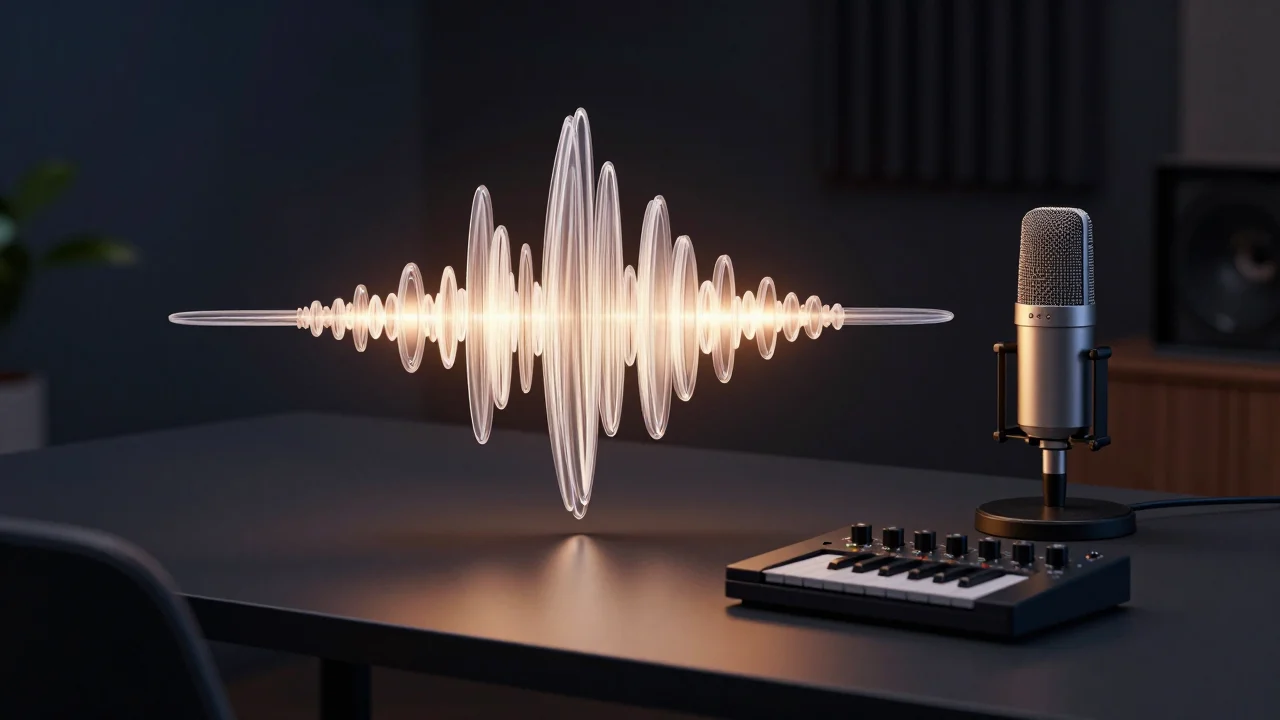
This time it's mostly about audio. ElevenLabs launched Eleven v4, its most expressive voices yet, and ComfyUI already has templates ready to use them (the node is on its way). For video, a team from Texas A&M and ByteDance takes MiniMax H3 from 50 to 4 steps with DMAD. And if you use ComfyUI with Qwen-Image 2.1, there's a fix you've been waiting for: 0.38.1 solves the crash with the int8 cache.
In short
- Eleven v4: new ElevenLabs voices with performance tags, multi-voice dialogue and over 90 languages; the ComfyUI templates are already out, the partner node is under review.
- DMAD: two LoRA that make MiniMax H3 generate video with audio in 4 steps instead of 50; Kijai has already converted them for ComfyUI.
- ComfyUI 0.38.1 and 0.38.2: fixed the Qwen-Image 2.1 crash with the int8/int4 cache; in the development branch the Luma Ray 2 nodes retire on October 24.
- Stability AI: according to TechCrunch, the Stable Diffusion company is rebuilding itself around music, backed by the three major record labels.
Eleven v4: voices that act, not just read
On September 28 ElevenLabs introduced Eleven v4 and the fast variant Eleven v4 Turbo (official announcement). The idea is that the model understands the tone from the text, instead of reading it flatly. The most useful new features for video makers:
- tags in the text like
[laughs]or ambient sounds like[light rain], plus acting directions written in natural language; - multi-voice dialogue where the speaker responds to what was just said, useful for ads and animations;
- over 90 languages, with the option of having the same voice speak different languages while keeping its identity;
- voice cloning from about 10 seconds of audio and the return of professional clones, which were missing in v3.
It's an online service: you can try it with a free account, and until October 12 ElevenLabs triples the credits on Creator plans and above. For ComfyUI, here's where things stand: the "speech" and "dialogue" templates for Eleven v4 are already in package 0.11.76, while the partner node with the v4 and v4 Turbo models is still under review. It will be paid, with Comfy credits.
Our take. For voiceovers on tutorials, ads and presentations, ElevenLabs quality has long been the benchmark, and performance tags cut down on lots of retries. But it's cloud-based and pay-per-use: if you produce many minutes of voice a month, costs add up. Having it inside ComfyUI is handy for putting voice and video in the same workflow; if you want to stay local, the alternative is open speech synthesis models, to be evaluated case by case for Italian.
DMAD: MiniMax H3 in 4 steps, audio included
Researchers from Texas A&M University and ByteDance released DMAD, a distillation technique that turns MiniMax H3 (33 billion parameters, video with stereo audio) into a generator with 4 steps instead of 50. In practice it's two LoRA of about 1.4 GB each, working at 1344×768. In the paper the authors report that human raters preferred their videos 79.1% of the time over DMD2 and 84.6% over rCM, two competing techniques (ties excluded). The weights are on Hugging Face and there's a short demo video ("DMAD", Zhengming Yu channel).
For ComfyUI, Kijai has already uploaded a lighter version of the LoRA to his MiniMax-H3-experimental repository (summary on ComfyUI Wiki). It's the second "few steps" shortcut for H3 in just a few days, after NVIDIA's LongLive-Plug, which we covered on October 1.
Our take. Going from 50 to 4 steps means much shorter times, which is exactly what you need when working with cards that aren't huge. But watch out: the authors' script is designed for an 80 GB GPU and downloads about 170 GB of model. On a 12 GB RTX 3060 you'd have to start from Kijai's quantized versions of H3, and we haven't verified that yet. And the most important point remains: the MiniMax H3 license excludes the European Union without a separate agreement, and that also applies to LoRA built on top of it.
ComfyUI 0.38.1 and 0.38.2: the Qwen-Image fix is here
After 0.38.0 on September 29, Comfy Org released two bug-fix versions, visible as tags on GitHub. 0.38.1 (September 30) fixes the crash that appeared when choosing the int8 or int4 cache with Qwen-Image 2.1, the issue we reported on September 30 as fixed only in the development branch. It also adds partner nodes for HeyGen Video 1.0 and Ideogram 4.5. 0.38.2 (October 2) brings the FLUX 3 Image node and the Grok Imagine Video 1.5 Lite model to the stable version.
In the development branch, on the other hand, there are three things to know:
- the Luma Ray 2 nodes are deprecated: the endpoints will be shut down on October 24, so workflows that use them need updating;
- on integrated GPUs "pinned" memory now turns itself off: good news if you use ComfyUI on laptops and mini PCs without a dedicated card;
- the Create Bounding Boxes node, the one you use to draw boxes for models like FLUX 3, will show the background image even when it comes from nodes that don't produce a preview (it also needs the interface update, not yet merged).
Our take. If you'd put off updating for fear of the Qwen-Image crash, you can now move to 0.38.2 with more peace of mind. The development-branch changes, on the other hand, aren't urgent: we'll wait for the next stable version.
Stability AI goes all in on music
According to TechCrunch, Sean Parker (Napster co-founder) and CEO Prem Akkaraju are rebuilding Stability AI as a provider of AI tools for music professionals. At the end of August the company raised 76 million dollars from Sony, Warner and Universal, which also licensed their catalogs for training. Three new audio models and a music editing software have already come out; an upcoming update will let you hum a melody or beatbox to guide the generation.
Our take. If you edit video, music generated from licensed data is good news: fewer doubts about the rights to your backing tracks. For those of us who grew up with Stable Diffusion, it's also confirmation of a change in direction. The article says nothing about the future of the image models: we'll keep following it.
Try it right away
If you use Qwen-Image 2.1 and the int8 cache was crashing ComfyUI, update. In the portable version for Windows, open the update folder and run update_comfyui_stable.bat: it takes you to the latest stable version (0.38.2). Make a copy of the custom_nodes folder and your workflows first, just to be safe. Then try the int8 cache again: on a 12 GB card like our RTX 3060, it's exactly what helps you stay within memory.
To choose the right models, you'll find everything in the guide to AI image models in ComfyUI and the one on AI video models in ComfyUI. If you're wondering how much pay-per-use services like ElevenLabs really cost compared to working locally, read how much it costs to create images and video with AI; if you're starting from scratch, begin with the beginner's guide to ComfyUI.
That's all for now. Download our free workflows from the ComfyUI section and follow us on the YouTube channel @tutorial3d: see you at the next update with the latest AI news.